Treatment Guide
MFU and HIFU lifting in Korea
The broader focused-ultrasound category — what it contains, how Korean clinics protocol it, and what international patients should ask before booking.
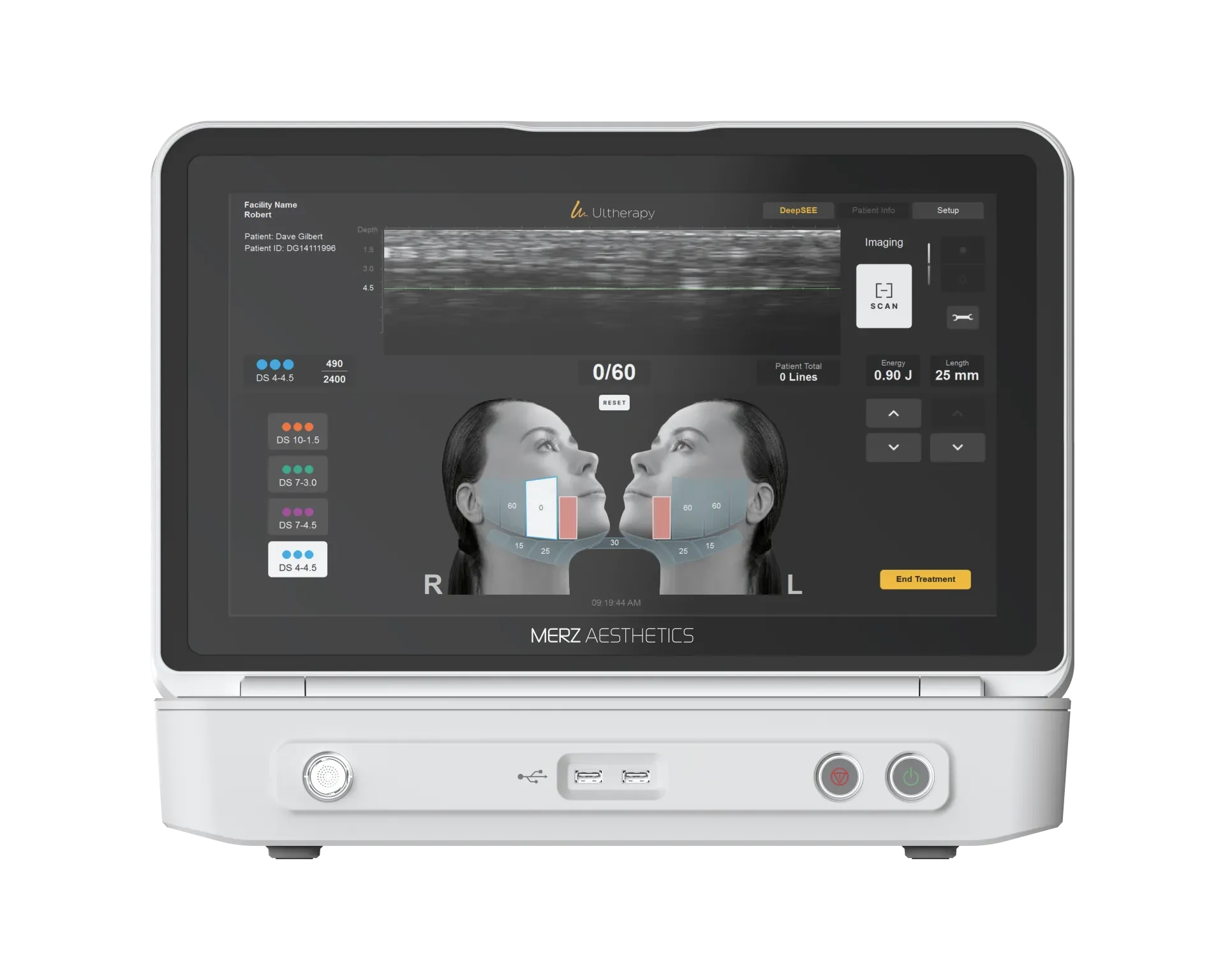
MFU (microfocused ultrasound) and HIFU (high-intensity focused ultrasound) are the broader categorical terms for the focused-ultrasound lifting modality that includes branded platforms like Ultherapy and Ultherapy PRIME but also encompasses non-Merz devices common in Korean clinics — Doublo, Liftera, Ultraformer III, Hironic Ulera, and others. The clinical principle is the same across the category: focused ultrasound delivers controlled thermal-coagulation zones at depths from the upper dermis through the SMAS, prompting collagen remodelling and a gradual structural lift over three to six months. The differences between specific platforms — and the reasons patients sometimes pay materially more for Ultherapy PRIME than for an unbranded HIFU treatment — sit in transducer engineering, depth precision, energy delivery consistency, manufacturer authorisation, and after-sales support. This page covers the patient-facing questions that apply across the category rather than to any single platform. For platform-specific coverage, see Ultherapy PRIME and Sofwave; for Thermage FLX, which is radiofrequency rather than ultrasound, see the Thermage FLX guide.
What the focused-ultrasound category actually contains
Korean clinic menus list a remarkable variety of focused-ultrasound platforms, and the variation is not merely cosmetic. Ultherapy and Ultherapy PRIME (Merz Aesthetics) are the regulatory benchmark — FDA-cleared for non-surgical lifting, with a manufacturer-published authorised-provider list and consistent energy-delivery characteristics across devices. Sofwave (Sofwave Medical) is the synchronous-parallel-beam alternative, working at intermediate dermal depth. Beyond the two named-brand platforms, Korean clinics commonly operate a wider field of HIFU devices: Doublo and Doublo Gold (Hironic), Liftera (Classys), Ultraformer III and Ultraformer MPT (Classys), Hironic Ulera, and several others. The clinical-practice difference between branded MFU and unbranded HIFU is not always large in skilled hands; the difference in regulatory standing, manufacturer accountability, and patient assurance is. International patients should know what platform a Korean clinic is actually proposing, and should expect the clinic to disclose the specific device by name in writing before booking.
How to read platform claims, honestly
When a Korean clinic markets 'HIFU lifting' without naming the device, the claim is genuine in the categorical sense but ambiguous in the specific. The platform might be a top-tier Korean-manufactured device with strong delivery consistency, or it might be a lower-cost device with less reliable energy output. The way to disambiguate is to ask three questions: which manufacturer made the device; which model and generation it is; and how recently the transducers were last replaced. Ultrasound transducers have a finite lifespan and degrade with use; clinics that operate high patient volumes need to replace transducers on a regular schedule, and the better practices document this. For Ultherapy and Ultherapy PRIME specifically, the Merz Aesthetics provider locator provides authoritative verification that a clinic is an authorised provider operating an authentic device. For non-Merz platforms, the equivalent verification is harder; patient diligence shifts onto direct questioning of the clinic and on the clinic's transparency in answering.
Why patients sometimes pay more for branded Ultherapy
The price gap between branded Ultherapy PRIME and unbranded HIFU in Korea can be substantial — sometimes a factor of two or three on similar shot counts. The price gap is not pure margin; it reflects four things. First, manufacturer cost: Merz transducers are more expensive to source and replace than transducers for non-Merz devices. Second, regulatory standing: an authorised Ultherapy PRIME provider is, by virtue of being on the authorised list, accountable to manufacturer protocols in a way that an unauthorised user is not. Third, energy-delivery consistency: branded transducers maintain calibration tighter and longer than commodity-grade transducers in many cases. Fourth, patient assurance: a patient who has paid for an Ultherapy PRIME knows what device was operated; a patient who has paid for an unbranded HIFU does not always. None of this means unbranded HIFU is bad — in skilled hands, with well-maintained equipment, the clinical result can be excellent. It means the price gap is not arbitrary, and a reasonable patient weighs the trade-off explicitly rather than treating the cheaper option as a no-cost substitute.
Protocol structure across the category
Most focused-ultrasound platforms in Korea are protocoled on a similar architecture: shot count distributed across multiple depths (typically 1.5 mm, 3.0 mm, and 4.5 mm for SMAS-targeting devices), region-specific patterning, and a single-session structure with annual or semi-annual maintenance. The face-and-neck protocol commonly runs 600 to 1,200 shots depending on the platform; some non-Merz HIFU devices price by line count rather than shot count, which makes direct platform comparison harder. The senior physician should photo-document the planned shot or line distribution at consultation and review it before treatment begins. Aftercare is simple across the category — topical SPF, no vigorous facial massage for 7 to 10 days, no sauna or hot yoga for 3 to 5 days — but the better Korean clinics provide written aftercare in the patient's working language and a coordinator channel for the first 14 days. Where these elements are missing, the protocol is, in our editorial reading, less serious than it claims to be.
Where MFU/HIFU sits in a comprehensive non-surgical programme
Most international patients in Korea do not receive MFU/HIFU as a standalone treatment; they receive it as part of a sequenced programme combining structural lifting with dermal tightening (Thermage FLX) and skin-quality work (regenerative bio-actives or thread lifting). The conventional sequence is structural first (Ultherapy PRIME or Sofwave), dermal second (Thermage FLX, separated by two to four weeks), regenerative third (exosome or growth-factor boosters, in the same trip 48 to 72 hours after structural work). The combination approach generates a more complete result than any single modality and matches well with the typical five-to-seven-day Seoul trip structure. The aftercare guide covers the post-procedure window across modalities; the pricing guide covers cost orientation across platforms. For specific clinic recommendations, see the regional archives — Gangnam, Myeongdong, and Incheon Airport — each of which links out to the specialised publisher archives we operate.
Frequently asked questions
What is the difference between MFU and HIFU?
The terminology overlaps. MFU (microfocused ultrasound) is sometimes used as the more clinically precise term for branded platforms like Ultherapy PRIME that target SMAS-level coagulation; HIFU (high-intensity focused ultrasound) is the broader category term that includes both branded MFU and a wider field of non-Merz devices. In Korean clinic marketing the terms are often used interchangeably.
How do I know which specific platform a Korean clinic is using?
Ask the clinic to disclose the manufacturer, the model, and the generation in writing before booking. For Ultherapy or Ultherapy PRIME, cross-check the clinic against the Merz Aesthetics provider locator. For non-Merz platforms, the equivalent verification depends on direct questioning and the clinic's transparency.
Is unbranded HIFU as good as Ultherapy PRIME?
It depends on the device, the operator, and the maintenance schedule. In skilled hands with well-maintained equipment, an unbranded HIFU result can be excellent. The price gap reflects manufacturer cost, regulatory standing, energy-delivery consistency, and patient assurance — none of which guarantees a worse outcome on an unbranded platform, but all of which a reasonable patient weighs explicitly.
How many sessions of MFU/HIFU should I plan for?
Most Korean protocols are single-session per modality, with annual or semi-annual maintenance. International patients commonly schedule the MFU/HIFU treatment as part of a sequenced programme with other modalities in a single Seoul trip, then return for maintenance twelve to eighteen months later.
What downtime should I expect?
Functionally zero across most focused-ultrasound platforms — mild erythema for a few hours, occasional transient swelling, low probability of small bruises at high-energy zones. There are no incisions, no general anaesthesia. Patients commonly attend evening appointments the same day.
Can MFU/HIFU treat the body in addition to the face?
Some platforms have body indications — Ultherapy PRIME is approved for décolleté, Sofwave has cellulite indications, and several non-Merz HIFU devices have body-contouring transducers for abdomen and thigh. Specific candidacy depends on the platform; consultation should confirm.